LNGSHOT is a four-member South Korean boy-group under the company MORE VISION. The group consists of: Kwon Ohyul, Kim Ryul, Jung Woojin and Louis Elliot Jordain Lim. They officially debuted on January 13th 2026 with the EP “SHOT CALLERS“.
THE EVENT:
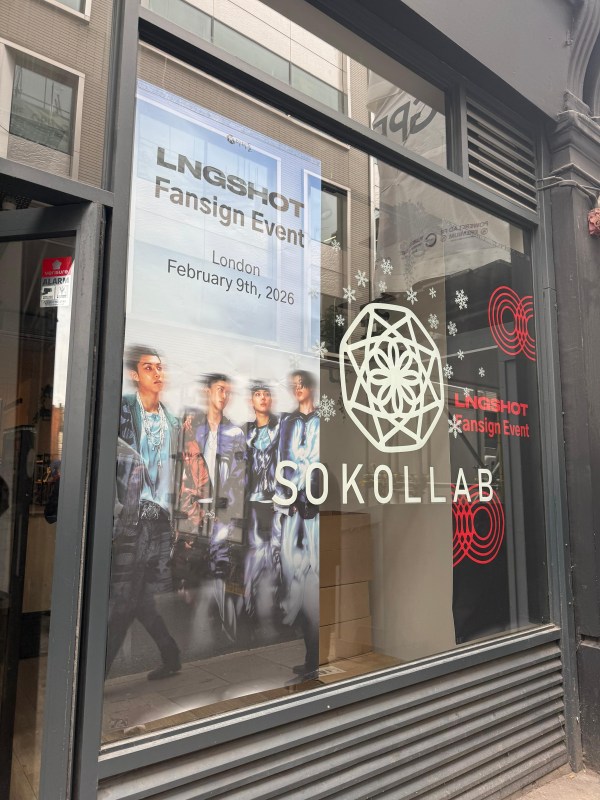
The event was hosted by SOKOLLAB at their store at 14 Rathbone Place, London, W1T 1HT on 9th February 2026. The actual event started at 3pm, though they asked fans to line up from 2-3PM to check-in. During the fan-sign, fans could greet artists and have a brief 30-second conversation during their turn with each of the members (Ohyul, Ryul, Woojin and Louis) till they are prompted by staff to move along.
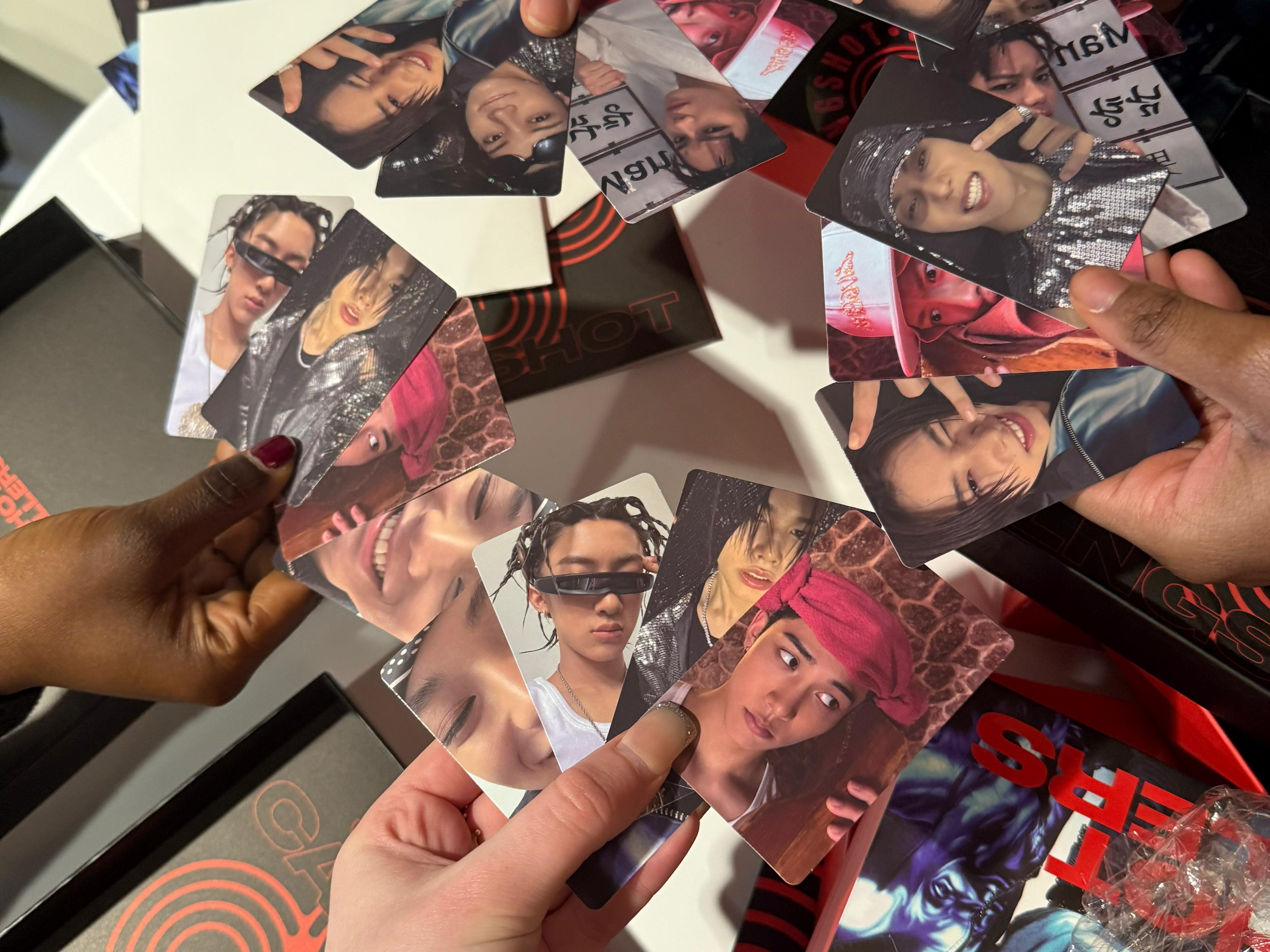
Fans album unboxings:Cece C, a fan who attended the LNGSHOT fansign:
“It felt like a really intimate interaction… you could connect with them on a different level.”
Her words reflect the emotional value fans placed on the opportunity to interact with the group in a more personal setting.
REFLECTIONS:
As fan-sign events are still relatively rare in the UK, the success of this event suggests there is a clear demand for more opportunities that allow fans to engage with artists in a more personal setting. Beyond fan engagement, events like this also serve as an effective way for artists and organisers to strengthen fan loyalty while supporting album and merchandise sales.
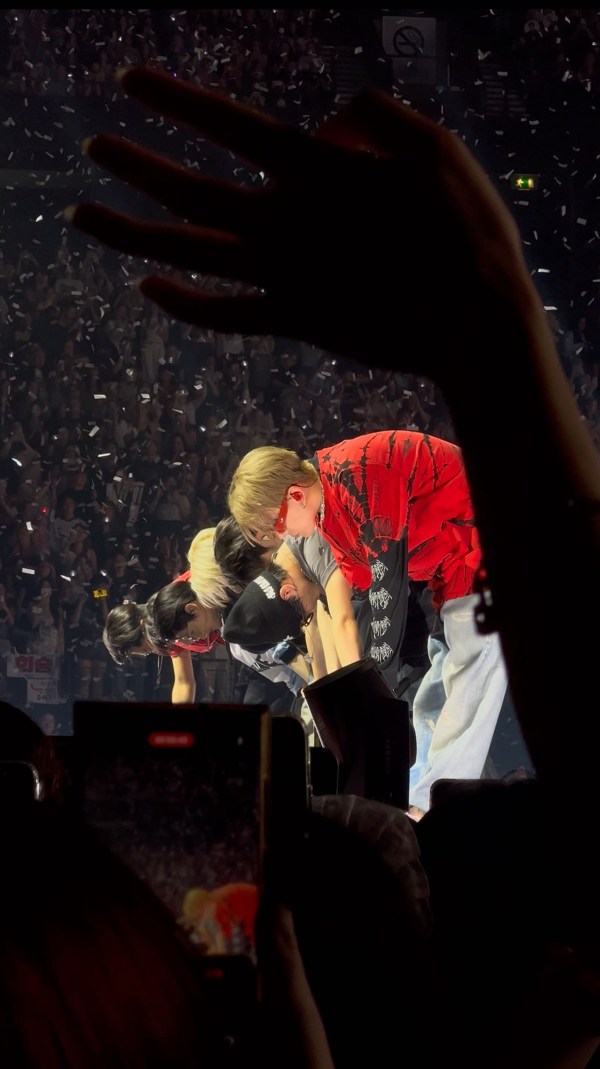
There are many types of tickets – one of them is a VIP ticket (sometimes referred to as VVIP or VVIP+). This is the ticket people usually fiend for as it allows fans to interact with the members after the concert ends. It is typically coordinated by staff, who take these ticket holders into a separate room where interactions happen in rows, depending on the venue’s management. These tickets range from £300-500 for this treatment.
Data Analysis
For this specific enquiry, I conducted my own research with an online survey to find out what people really think of VIP send-off.
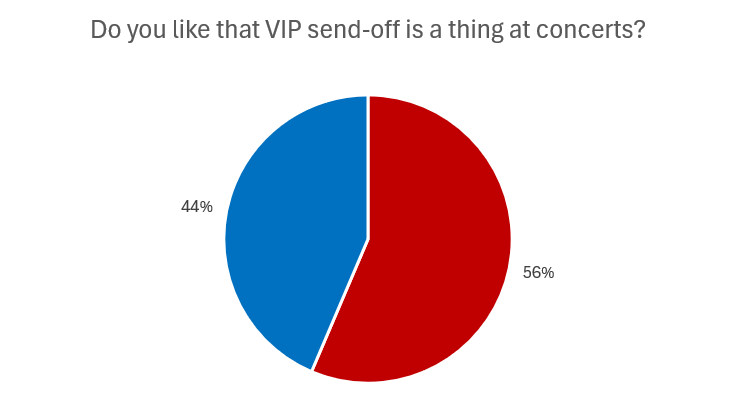
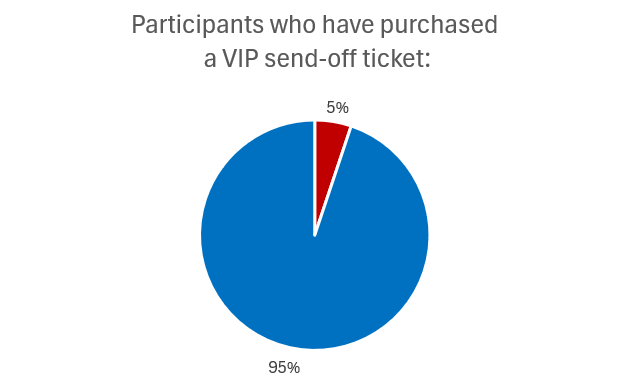
56% of participants said they do like that VIP send-off is an opportunity for concert-goers, whereas 44% disagree. Although 55% like the concept of it, only 5% of participants have actually purchased a ticket. Why is that? Well, good thing I asked 😉! I asked participants how the experience was if they attended, or why they didn’t purchase a VIP ticket.
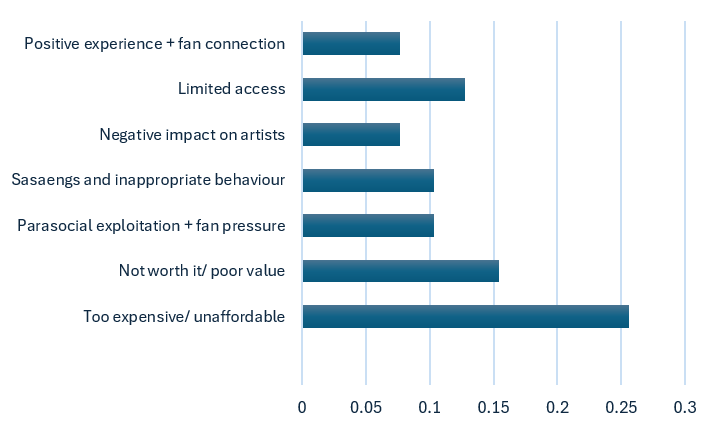
From the figure, the common themes identified are all negative besides one of them which is the positive experience and fan connection, though it is one of the lowest ranked themes (7.7%). Over a quarter of respondents (25.6%) cited cost as the primary barrier, while concerns around value, access, parasocial pressure, and safety each accounted for roughly a tenth of responses.
While the chart highlights the most common reasons respondents have not engaged with VIP send-off, it does not capture the intensity or reasoning behind these views. To explore this further, participants were asked directly for their opinions on VIP send-off pricing and the experiences they have seen which have influenced their responses.
The prices of these tickets were repeatedly mentioned to be excessive and disproportionate with the time spent with the artists:
“Literally outrageous.”
“Paying an extra £100-200 to spend maybe 3 seconds with each member of the group (if you’re lucky) is so unfair.”
“Daylight robbery.”
Other respondents echoed similar concerns, arguing that no concert experience should exceed £200 without a guaranteed meet-and-greet. Several participants compared send-offs unfavourably to cheaper fan interactions such as fan-calls, questioning why significantly higher prices offer less certainty.
Inequality and Hierarchy among fans:
Participants raised concerns that these tickets were only for wealthy fans and a way of showing superiority to other fans:
“Only accessible to people who view that money as pocket change.”
“Pressures other people to spend more due to emotional attachment.”
“Those with more money get special treatment and feel “closer” to the artist.”
Other respondents claimed to know people who have only gone if they have gotten VIP, and if not they don’t go at all, hinting that they view the regular tickets as inferior.
Organisation Failure:
To actually begin the send-off experience, VIP ticket holders are ushered into another area where they wait for the artists to come in and speak to them. However, from the responses given, majority believe that although the artists are there, it is not enjoyable for everyone:
“It’s such a messy way for fans to meet idols.”
“Overselling of the ticket makes it suffocating for both fan and artist.”
To elaborate further, people are called in rows, which are randomised and highlights the intensity of the interaction will be based on luck.
Emotional Labour and Artist Well-being:
After performing for a maximum of four hours, which is dancing whilst singing to the best of their ability, they are expected to act over the moon in-front of their fans. Do not get me wrong, I am certain they love their fans, but after a long day, I’m sure it’s not one of the first things they’d like to do.
“It dehumanises idols – like they’re just products.”
“They have to force a smile after performing for hours.”
“Can be stressful having people waving things at you to sign and phones all around.”
“It’s draining for both sides.”
Most respondents agreed and said their enthusiasm during this time is situational and may not be a great experience for everyone.
Parasociality, Entitlement and Fan Behaviour:
It is no secret that most fans buy these tickets to stand out amongst other fans and have their interaction go viral on X or TikTok.
“Some fans just buy it for a Y/N moment.”
“It pushes unhealthy parasocial relationships and blurs the line between admiration and intimacy.”
“There will always be “fans” that forget their limits and make artists uncomfortable.”
“Fans act absolutely insane and put their idols in danger without realising it.”
It can be frustrating for artists trying to divide their attention to all the fans in front of them whilst they are having their name called left, right and centre.
Anecdote:
For me, I personally do love seeing send-off videos and have wanted to be in the OP’s shoes, but when I actually think about how those people got there, I automatically try to forget about it. I believe spending half a grand on artists, no matter how much they may have helped you, puts them on a pedestal, and makes you seem inferior to them. Also, the artists know how around how much would have been spent to be there. Personally, I’d feel ashamed that I’ve gone to these lengths for an interaction which lasts less than two minutes. However my perspective may be swayed by my religious beliefs.
I believe having fan-meets (ticket-sold, not raffle-won) as separate events would be much more appropriate and hassle-free for both parties.
Before I begin to yap, I am not trying to kill the fun of the show, I thoroughly enjoyed the show, but that doesn’t erase how stressful it is – I was quite literally gripping sofa during Season 3 Episode 4’s game. From the very first season, we are not eased into the horrors it displays, we are flung into high-stakes of violence, with bright colours and eerie music. When did our idea of entertainment become so anxiety-inducing?
DATA ANALYSIS+ ANECDOTE WITHIN
Squid Game didn’t just just torment its characters, also the viewers; according to ScreenRant, the second season of the show garnered 68 million views in the first three days and became number one in every country on Netflix! That is insane – we all know good shows but for them to excel everywhere?? What’s crazy is that it isn’t a lighthearted fun show – people were tuning in to feel tension.
A study by Mathias Clasen and Marc Andersen involved running several experiments in a haunted-house setting in Denmark which they called “Dystopia”. They hooked heart rate monitors to the participants and recorded how scared they felt and how much enjoyment they felt throughout. They found the participants’ results to have an upside-down U-shape; if participants weren’t scared at all, it wasn’t fun, but if they were too scared the enjoyment level dropped. Andersen worded it as “It is as if humans dislike being very far from their normal physical state but we seem to like being out of our comfort zone,”. This makes sense when applying it to Squid Game; we do not want real physical harm but we enjoy the thrill – the feeling of being off-balance.
The last game in Season 3 Episode 4, let’s be so for real, we all KNEW that Jun-hee was going to die before she even got eliminated, so why were most of us bawling? Even after that you continued to watch it at “torture” yourself, when you KNEW it was going to be emotionally scarring. ACTUALLY NOT EVEN THAT – WAS SEASON ONE NOT ENOUGH FOR YOU?! God bless my girl Sae-Byeok, Ji-yeong and Ali 😔- literally became ill from the amount of tears that were shed.
Anyway, so you’re not insane for finding joy in these types of shows !

 mominatalks